
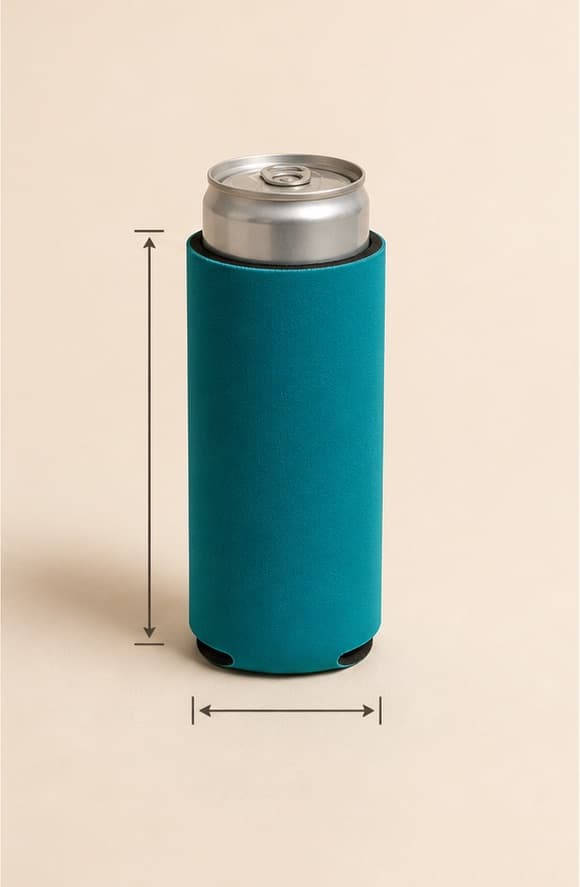
Short answer: choose a custom can cooler by the container’s actual diameter, circumference, height, taper, and desired coverage—not by fluid capacity alone. A “12 oz” standard can and a “12 oz” slim can may hold the same volume but need different neoprene patterns. For a reliable custom order, send the container drawing or measurements, select the construction, and approve a physical fit sample before bulk production.
A neoprene can cooler looks forgiving because the material stretches, yet small fit errors are easy to feel. A sleeve that is too loose rotates around the can, hides the artwork at an angle, and can slide off when the drink is lifted. A sleeve that is too tight is slow to load, pulls hard across the side seam, and may trap the can through suction at the base. For a brand, brewery, promotional distributor, or private-label buyer, those details affect the user experience long after the purchase order is signed.
At EDIOM SPORTS, our practical starting point is always the container. We have worked with neoprene product development since 2008, and the repeatable lesson is simple: the product name on a spreadsheet is not enough to define a pattern. This guide explains the information a factory needs, how the main beverage-can families differ, what to inspect in a sample, and when a custom pattern is worth the extra development step.
Why ounce capacity is not a complete size specification
Fluid capacity tells you how much the container holds. It does not uniquely define the outside geometry that touches the sleeve. Two cans with the same nominal capacity may differ in body diameter, overall height, top-neck profile, lower-wall radius, and the transition into the base. Regional packaging formats add another layer: a “standard” can in one market may not match the most common profile in another.
Neoprene accommodates a controlled amount of stretch, but stretch should support the fit rather than compensate for missing information. The laminated face fabric, foam thickness, printing process, and seam all influence the finished elasticity. A 3 mm laminated sheet does not behave exactly like a thicker, stiffer sheet. A fully sublimated polyester face may also recover differently from a solid stock fabric. Pattern decisions therefore belong to the complete specification, not to a single dimension.
The four measurements that matter most
- Maximum body diameter or circumference. Measure the widest functional section of the can. If you send circumference, keep the tape level and do not compress the container.
- Overall container height. This helps the developer understand proportion, even when the sleeve does not cover the entire can.
- Target sleeve height. Define how much metal should remain visible above the sleeve and whether the bottom must sit flush, wrap underneath, or remain open.
- Profile changes. Record taper, shoulders, grooves, rims, handles, or other geometry that can interfere with insertion or artwork.
Standard, slim, and tall-boy can cooler families
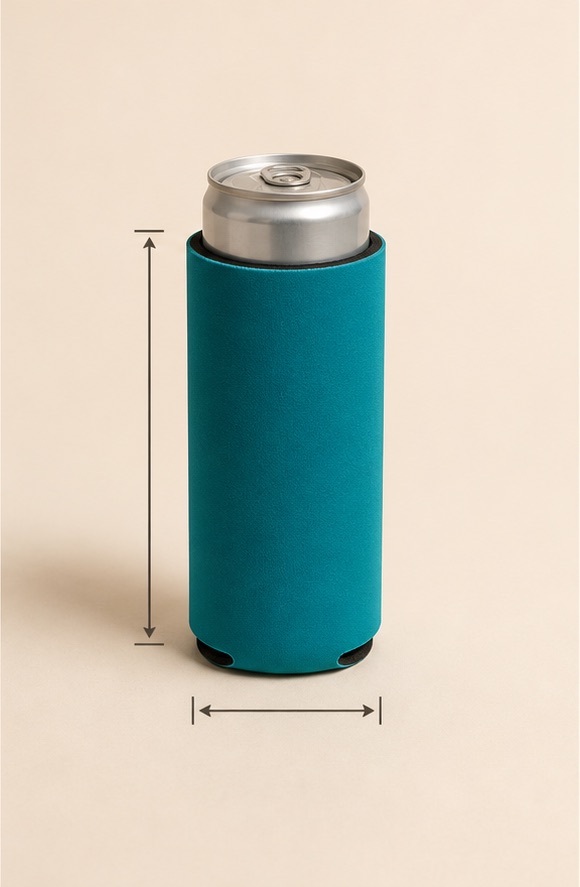
Most enquiries can be organized into three starting families. These labels are useful for conversation, but they should not replace final measurement approval.
| Starting family | Typical use | Main fit risk | Best confirmation |
|---|---|---|---|
| Standard can | Mainstream beverage and beer cans | A generic pattern may be loose or cover too much of the top shoulder | Body diameter, height, and physical sample |
| Slim can | Hard seltzer, energy, sparkling beverage formats | A standard sleeve may rotate or fall away from the narrower body | Diameter/circumference and sleeve height |
| Tall boy | 16–24 oz and other taller formats | Incorrect height-to-width proportion can distort artwork and seam load | Full container drawing or actual can |
| Custom profile | Regional cans, shaped bottles, tumblers, specialty containers | Taper, shoulder, base, or protrusions are missed | Physical container plus approved prototype |
Standard can coolers
A standard collapsible can cooler is the familiar promotional format: a rectangular or subtly shaped neoprene body, side seams, and a base construction that supports the can. It is efficient to pack and offers a large printable area. The word “standard,” however, refers to a common starting pattern—not a promise that every local 12 oz or 330 ml can is identical.
For repeat programs, document the exact beverage brand or packaging drawing used during approval. If a marketing campaign later changes to another can supplier, retest the sleeve. A few millimetres of body difference can alter insertion force and artwork position.
Slim can coolers
Slim cans need a narrower pattern and often a taller printable field. Simply placing a slim can inside a standard sleeve usually produces excess space, rotation, and an unfinished appearance. The correct pattern should grip without requiring the user to force the can through the opening. If multiple slim formats are planned, compare all of them before deciding that one sleeve can serve the complete range.
Tall-boy and large-format can coolers
Taller cans increase leverage on the sleeve and make proportion more visible. A sleeve that is too short may feel visually weak; one that is too tall can interfere with the drinking area or make removal difficult. Artwork must be planned around the longer seam and the natural hand-hold zone. A tall format also uses more material and may change carton quantities, so the packaging calculation should be confirmed with the final pattern rather than copied from a standard-can quotation.
How a factory converts measurements into a finished pattern
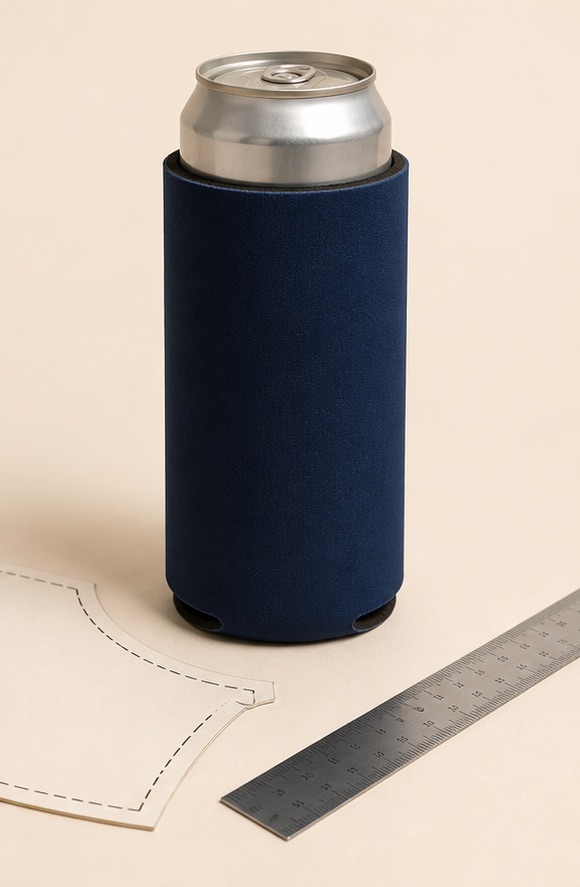
The finished flat width is not simply equal to the can circumference divided into panels. Developers consider seam allowance, foam compression, fabric stretch, material thickness, base construction, and the amount of negative ease required for grip. Printing can happen before cutting and sewing, so the artwork template must also reflect safe zones, bleed, seam overlap, and the way the design wraps around the finished body.
This is why buyers should avoid editing a template from another supplier without confirmation. Two factories may use different seam allowances, cutting tolerances, or base methods. Ask the selected manufacturer for the current production template after the structure and size are agreed.
Negative ease: grip without excessive loading force
Negative ease means the relaxed sleeve is slightly smaller than the container area it must cover. The material stretches during insertion and then grips the can. Too little negative ease creates a loose fit; too much increases seam stress and loading difficulty. There is no useful universal percentage for every neoprene construction because face fabric, thickness, lamination, and seam design change the result. A sample on the real container is the reliable decision point.
Base construction changes the fitting behaviour
An open-bottom sleeve slides over the container and may accommodate a broader range of heights. A sewn or inserted bottom supports the can but introduces base geometry and possible air resistance. A small vent or suitable construction can make removal easier. Wrap styles, snap wraps, and adjustable closures solve different jobs again: they may trade a tailored silhouette for broader compatibility or flat shipping.
What to send with a custom size enquiry
A complete first message reduces clarification rounds and helps the supplier quote the correct development route. Send as much of the following as is available:
- container type, nominal capacity, brand, and destination market;
- maximum diameter or circumference and overall height;
- target sleeve coverage height and preferred construction;
- neoprene thickness preference, or the required balance of feel, insulation, and packing volume;
- artwork complexity, number of colors, and preferred printing method if known;
- quantity per design and per size;
- packaging requirements, target delivery date, and destination country;
- whether a physical container can be sent for development.
If the container drawing is confidential, ask the supplier how technical files are handled before sending it. A simplified dimensional drawing may be sufficient for an initial feasibility review, while the physical container can follow for sampling.
The seven-point physical sample fit test
A photograph proves appearance, not performance. Use the approved production container and repeat the following test on the physical pre-production sample:
- Insertion: the sleeve should load without excessive force or rolling the top edge.
- Grip: rotate and lift the can; the sleeve should not spin freely or fall away.
- Top exposure: confirm that the drinking rim and intended brand area remain accessible.
- Bottom seating: check whether the can sits fully and whether trapped air makes removal difficult.
- Seam stress: inspect side and base stitches while the can is inserted. They should not look overextended.
- Artwork position: review the front, back, seam, and hand-hold area. A perfect flat proof can still wrap poorly.
- Repeated use: insert and remove the can multiple times, then check recovery, edge shape, print, and stitching.
Common sizing mistakes and how to prevent them
Mistake 1: approving only from an ounce label
Prevention: attach the container drawing or provide measured dimensions. Identify the exact can used for the sample approval record.
Mistake 2: using a paper printout as the only fit proof
Prevention: use a digital or printed artwork proof for layout, then approve a sewn physical sample for fit and hand feel. These are different approvals.
Mistake 3: asking one fitted sleeve to cover incompatible profiles
Prevention: test every target container. If one pattern cannot deliver an acceptable result, split the order by size or choose an adjustable construction.
Mistake 4: changing material after sample approval
Prevention: treat thickness, face fabric, and lamination as part of the approved size. A material substitution can change stretch and fit even if the cutting outline is unchanged.
Mistake 5: ignoring packaging until the end
Prevention: request a packing proposal using the final dimensions and thickness. Larger or thicker sleeves reduce units per carton and can materially affect freight.
How to write the approved size into a purchase specification
Do not rely on “standard size” as the final purchase-order wording. Record a style code or approved sample reference, target container, finished dimensions with an agreed tolerance, material construction, print method, artwork revision, seam/base method, packaging, and approval date. If the supplier maintains a golden sample, identify it in the order documents.
A useful specification line might read: “Collapsible neoprene can cooler developed for the buyer-supplied container reference, produced to approved sample revision B, with approved laminated material, full-color sublimation artwork revision 3, sewn base, and individual packaging as confirmed.” The exact wording should match the documents actually exchanged; never insert a tolerance or performance promise that has not been agreed.
Example: approving one campaign across three beverage formats
Imagine a beverage brand planning a launch with a 12 oz standard can in the United States, a slim can for a European sampling program, and a 16 oz can for an event partner. Treating all three as one “can cooler” creates hidden risk. The purchasing team should first build a container schedule with a photograph, manufacturer reference, measured diameter, height, and required sleeve coverage for each market. The artwork team can then decide whether the same visual should be adapted to three templates or whether each market needs a different layout.
Ask the supplier to identify which existing pattern is closest to each container and where a new pattern is required. Sample the actual material and construction—not a substitute fabric—because stretch influences the result. During approval, photograph each sample from the front, back, side seam, top, and base while fitted to the named container. Record any intentional differences, such as greater top exposure on one format. This small approval pack gives procurement, marketing, and the factory the same reference.
If the campaign later adds another can, do not assume that the nearest approved size is automatically acceptable. Run the fit test again and record the outcome as a new variant. The disciplined approach can look slower during quotation, but it reduces artwork rework, mixed packing, and arguments about what “fits” after the products reach different markets.
A concise RFQ example
“Please quote custom neoprene can coolers for the attached three-container schedule. Quantity is 1,000 pieces per artwork and size. We require full-color printing, individual recycled-content bags if feasible, delivery to California by the stated event date, and a physical pre-production sample for each size. Please show sample cost, bulk unit price, packaging, production start condition, estimated carton data, and any pattern-development charge separately.” This gives a supplier enough context to ask precise follow-up questions without forcing the buyer to complete a long retail-style form.
Final recommendation
Use standard, slim, and tall-boy labels to start the conversation, then move quickly to measurements and a sample. The best custom can cooler is not the one with the most aggressive stretch. It is the one that loads naturally, grips consistently, presents the artwork correctly, survives repeated use, and can be reproduced in bulk against a clear approval record.
If your program includes an unusual can, bottle, tumbler, or multiple regional containers, build the fit decision into product development before the artwork is finalized. That sequence saves more time than forcing a near-match pattern to work after printing has begun.
Methodology and editorial disclosure
This guide was prepared from EDIOM SPORTS’ product-development workflow and common fit questions received during custom neoprene sleeve projects. It provides a purchasing framework, not a universal engineering tolerance. Container geometry and material behaviour must be confirmed for each project. The three supporting visuals are AI-generated illustrations created for explanation; they are not laboratory results or photographs of a specific customer order.